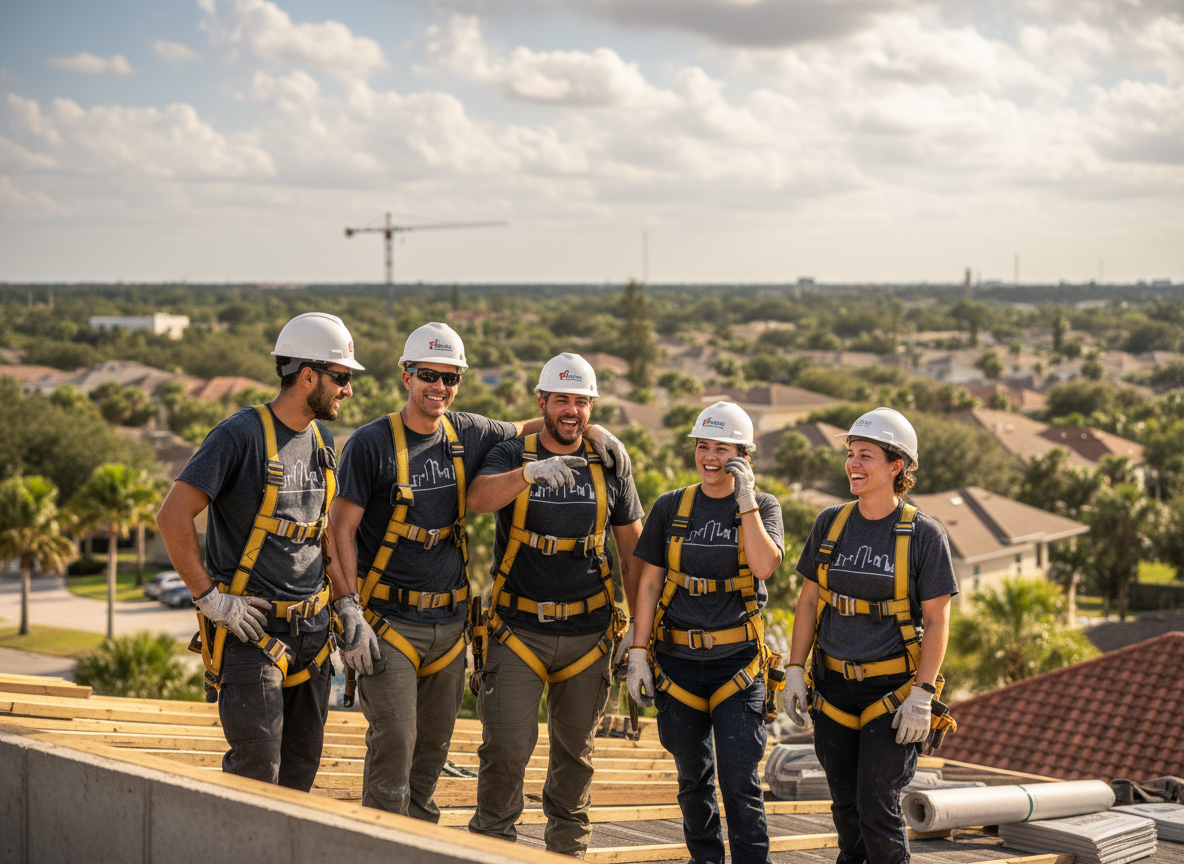
South Florida runs from Miami and Fort Lauderdale through West Palm Beach and Boca Raton to Naples, Fort Myers and Cape Coral, and it is the most demanding roofing environment in the state. Much of it sits in or near the High-Velocity Hurricane Zone, tile is the dominant covering on the coastal stock, and salt air is in contact with every surface all year. Roofing here is a code question, a membrane question and a corrosion question at the same time.
Which Cities Do We Cover Here?
Miami, Fort Lauderdale, West Palm Beach, Boca Raton, Hollywood, Coral Gables, Naples, Fort Myers and Cape Coral, plus the communities around them. Our office is in Orlando and this is one of the five Florida regions we work across. There is no branch office in South Florida, and no staff are claimed to be based here.
What Makes South Florida Roofing Different?
The High-Velocity Hurricane Zone. Miami-Dade and Broward counties fall within it, and the Florida Building Code applies a separate chapter to roofing work there: specific underlayment methods, product approval requirements for materials, and attachment rules that reflect the wind exposure. A roof that would be compliant in Central Florida is not automatically compliant in Miami-Dade.
Tile is the other factor. Concrete and clay tile cover a large share of the residential stock, and the tile is not the waterproof layer. When a South Florida tile roof leaks it is almost always the underlayment beneath it, and on roofs from the 1980s and 1990s that membrane has generally reached the end of its life.
Salt air is the third. It attacks fixings, flashing and metal components under the covering, which is why coastal roofs fail at their hips and terminations before the field looks worn.
The 25% Rule and Roof Age
Florida law allows a roof that was built or replaced under the 2007 Florida Building Code or later to be repaired in sections even past 25% of its area, with only the repaired portion brought up to current code. South Florida has a large stock of roofs from before that date, so the permit record for the last roof decides what a repair is allowed to be, and it is worth finding before a scope is agreed.
Insurance pressure is part of the same conversation. Roof age is a live question at renewal, insurers must allow an inspection for older roofs, and a dated record of condition is what the discussion turns on.
Permits and Code Across South Florida
Roofing work is permitted by the local building department under the Florida Building Code, which in this region means Miami-Dade County or one of its municipalities, Broward County or a city within it, Palm Beach County, Collier County for Naples and Lee County for Fort Myers and Cape Coral. Each has its own process, and inside the High-Velocity Hurricane Zone the inspection stages are specific.
Because of that, the address is the first thing that decides anything about a South Florida roof. Two houses on the same street can sit under different building departments.
Roof Types Across South Florida
Concrete and clay tile dominates the coastal residential stock, in barrel, S-profile and flat profiles. Shingle appears on inland and older subdivisions. Metal has grown on newer construction, in both concealed and exposed-fix systems. Low-slope membranes cover the commercial stock, the condominium buildings and the mid-century flat sections.
Each of those has its own failure pattern, and the tile roof is the one most often misdiagnosed: an intact tile field over a failed membrane looks exactly like a sound roof from the ground.
What to Have Ready When You Call
The address, because it decides the building department and whether the High-Velocity Hurricane Zone applies. The covering type, or a photograph from the ground. The date of the last roof permit if you can find it. And the reason for the call: a leak, storm damage, an insurer's letter, or a plan. Florida Roof Repair Pros, 4720 Millenia Blvd, Suite 175, Orlando, FL 32839, (407) 557-4529.
Around South Florida
We regularly work near:
- 📍PortMiami
- 📍Las Olas Boulevard, Fort Lauderdale
- 📍Worth Avenue, Palm Beach
- 📍Naples Pier
- 📍Sanibel Island, Lee County
Roofing Company in South Florida — Local Notes
- •High-Velocity Hurricane Zone rules apply in Miami-Dade and Broward
- •Tile dominates the coastal stock; the membrane beneath it is the waterproof layer
- •Salt air attacks fixings, flashing and metal components first