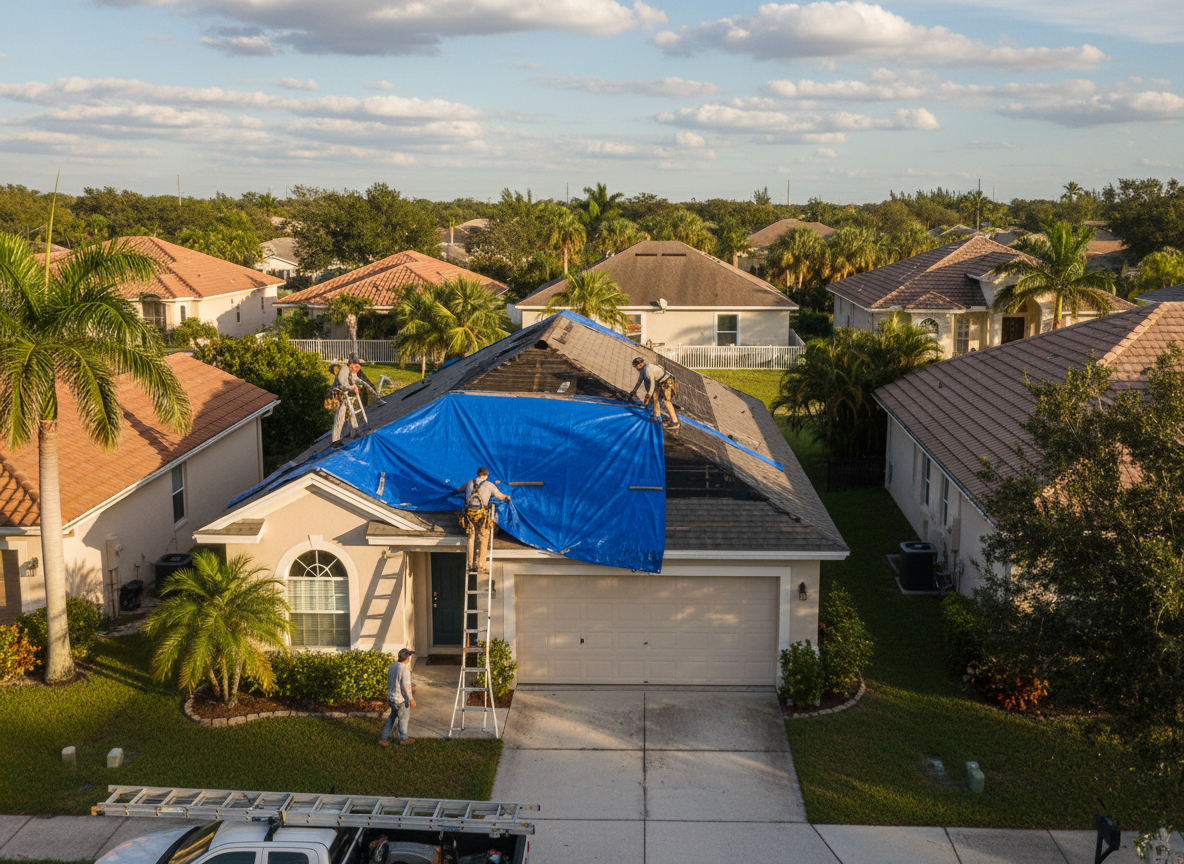
It is late evening, a band of thunderstorms is sitting over the county, and water is running down the inside of a wall. The hallway ceiling has begun to sag. Every hour that water keeps moving, more drywall, insulation and ceiling board gets wet, and what would have been a section of roof becomes a section of roof plus a ceiling. Emergency roof repair in Florida is not a dramatic rescue. It is the work of stopping water from spreading through the building tonight, drying the structure into a stable condition, and leaving you with a written record of what was found so a permanent repair can be planned. The phone number for that is (407) 557-4529.
What Should You Expect From a Roofer at Eleven at Night?
You should expect three things: questions that narrow down where the water is coming from, a plan for the next few hours that you can act on yourself, and a written record of what was found. Not a sales visit.
The first call is mostly diagnosis by description. Where is the water showing? Is it running, dripping or just staining? Which direction was the wind blowing? Is there a bathroom, a chimney or a skylight anywhere near the stain? Those answers decide whether the visit is a make-safe job or a temporary cover, and whether you need to move furniture and switch a circuit off before anyone arrives.
The second thing is a make-safe, not a rebuild. An emergency call at night is there to stop water reaching the building fabric and to remove anything that has become dangerous, such as a loose roof edge, a displaced ridge cap or a tile hanging over a walkway. Permanent work needs daylight, the right materials and, in Florida, usually a permit.
The third thing is the record. Photographs of the roof and the interior with a date, a note of where the water entered and where it travelled, and an itemized list of what was done on the night. That record is what you keep, and it is what any later conversation about scope starts from. We do not publish ratings, review counts or years in business. We do publish one address and one phone number, and they are the same on every page of this site.
Why Can't an Active Leak Wait Until Morning?
Because water inside a roof assembly does not stay where it lands. It follows the deck, the battens and the ceiling joists, and it keeps soaking new material the whole time.
Florida makes this worse than most states. Much of the peninsula sees more than 50 inches of rain in a year, and a large share of it arrives in short, violent afternoon and evening storms between June and November. A single stalled cell can drop two inches in an hour. A roof opening that sheds a drip during a light shower can move gallons through a ceiling cavity in that hour, and the water arrives somewhere you are not watching: inside a wall cavity, above a soffit, behind a light fitting.
The damage ladder is predictable. First the ceiling board softens and sags. Then insulation, which holds water like a sponge, stays wet for days and keeps the ceiling damp from above. Then the timber it sits against starts to swell and stain. Ceiling and insulation work is interior work, and it is usually the larger invoice. Stopping the water early is the cheapest part of the whole sequence.
There is an electrical risk as well. Water that reaches a ceiling rose, a recessed light or a fan box can energise metal parts that a hand would normally touch safely. That risk is one of the reasons an active leak belongs in the emergency category rather than the weekend list.
And there is a records reason. Florida gives a homeowner one year from the date of loss to give notice of an initial or reopened property insurance claim, and 18 months for a supplemental claim. Damage photographed and described the week it happened is straightforward to date. Damage described a season later is a conversation about cause.
What Proof Should a Roofer Put in Your Hands?
Documentation, and the ability to check it. Ask for all of the following, on paper or by email, and keep it.
- Dated photographs of the roof area, the entry point and the interior damage, taken during the visit, not after the repair.
- A written description of the water path: where it entered, which way it travelled, and where it showed up inside.
- An itemized list of the make-safe work that was actually done on the night, including materials used.
- The permit position. Roofing work on a Florida building is permitted by the local building department under the Florida Building Code, and in Miami-Dade and Broward the High-Velocity Hurricane Zone chapter adds its own requirements. Ask which office covers your address and whether the permanent repair will need a permit.
- Product approval details for anything that will be installed permanently, since roof coverings and their components are approved products in Florida.
- Contact details that never change. Ours are Florida Roof Repair Pros, 4720 Millenia Blvd, Suite 175, Orlando, FL 32839, and (407) 557-4529.
When the Leak Only Appears If the Rain Comes Sideways
Some roofs are watertight in a straight-down shower and leak in a storm that drives rain at the wall at an angle. Those calls usually come in clusters during tropical systems, and they are easy to misdiagnose.
A homeowner in a 1970s block-and-stucco house calls during a feeder band. Water is running down the inside face of an exterior wall, the ceiling near the wall is damp, and there is a stain spreading along the joint between wall and ceiling. From the ground the roof looks intact. There is no missing tile, no lifted shingle, no hole. The obvious conclusion, that the roof covering has failed, is usually wrong.
What is happening is wind-driven rain intrusion. Rain pushed at 40 mph against a wall finds the small openings a wall always has: the joint where the roof covering meets the wall, the top of a window or door frame, a stucco crack, an abandoned cable penetration, the junction under a weep screed. Water gets behind the exterior finish, runs down the wall cavity, and shows up at the ceiling line. The roof covering was never breached. Sealing the roof would not have stopped it.
The diagnostic order matters here. Start inside, in the attic if there is one: which end of the house is wet, and is the wet timber above or below the wall line? Then look at the exterior at that same elevation for the openings above the wet point. Only then look at the roof covering, and specifically at the wall-to-roof junction, which is a flashing detail rather than a covering detail.
Temporary work for this is different too. A tarp over the roof field does nothing for a leak entering at a wall. The useful temporary measures are at the elevation that is leaking: sealing the wall junction, covering the window head, or stopping water reaching the wall with an overhang.
The repair is a flashing and wall-detail repair, plus drying of the wall cavity. If the cavity has been wet for a while, the stucco and the sheathing behind it may need to be opened to dry. That is a bigger job than a roof patch, and it is why guessing costs money: a roofer who seals the roof and walks away leaves the actual entry point open for the next storm.
What Emergency Roof Work Actually Covers
Water Coming Through a Recessed Light
A recessed light in a ceiling is an open path. The can sits in a hole cut through the ceiling board, and water travelling across the top of that board collects at the lowest point, which is often the fitting.
Treat it as electrical first. Switch off the circuit at the breaker, and do not touch the fitting until it is off. Then put a container underneath, and photograph the ceiling around it before anything dries.
Water arriving at a light fitting has usually travelled along a joist or the underside of the deck. The fitting is where it exits, not where it enters. A repair aimed at the ceiling above the light is aimed at the wrong place.
Tell whoever you call that the water is at a light fitting. It changes the triage: the circuit question comes first, and the roof question second.
Storm-Damaged Roof Edge, Soffit and Fascia
Wind does not only lift coverings. It gets under the edge of a roof and pulls. Fascia boards, soffit panels and the gutter that hangs from them are the first things to let go in a Florida storm, and once the edge is open, rain is driven straight into the roof cavity.
A displaced soffit panel is also a hazard over a walkway. It is a make-safe item, not a wait-until-Monday item, and it usually needs a temporary fixing rather than a permanent one at night.
Photograph the edge from the ground before anything is touched. The position of the damage, and which elevation it is on, tells you which wind direction caused it, and that is the detail that makes a storm claim coherent.
What a First Visit Can and Cannot Fix
A first visit in the dark can stop water, remove a hazard, document conditions and confirm which repair is needed. It cannot install a permanent roof covering, and it should not try.
Sealants applied to a wet surface fail. Tiles reset in the dark without checking the underlayment underneath are a guess. Metal work measured by torchlight is measured wrong.
That is why the honest sequence is make-safe, document, return in daylight with the right materials and, where required, a permit. Anyone offering to complete a permanent repair of an unknown roof at night is skipping the diagnosis that the repair depends on.
What Should You Do While You Wait?
Move things, not water. Get furniture, rugs, electronics and anything on the floor out from under the leak, and put a bucket or a wide container underneath the drip. A towel around the container stops splash spreading into the ceiling board.
Kill the power to any circuit near the water at the breaker, and leave it off until the area is dry and checked. If water is anywhere near a light fitting, a switch or a socket, that is not optional.
Do not go on the roof. A wet Florida roof is slippery in a way that is hard to appreciate from the ground: tile and metal are both treacherous when wet, and after a storm there may be damaged covering that will not take weight. Photograph from the ground instead, from each side of the house, with the date visible.
If the ceiling is bulging, do not stand under it and do not prod it from below while it is full. A bulging ceiling board holds water and will come down. Clear the area, put sheeting down, and let it be dealt with by someone with a ladder and a knife who knows where to open it.
Write down what you saw and when. Time of first sighting, which rooms, which direction the wind was blowing, and whether the roof looked any different before the storm. That note is worth more than memory a month later, and it costs nothing to make.
Then call. Describe the water, not the roof: where it is showing, whether it is running or dripping, and what is directly above it inside the house. With that, the visit can be planned instead of improvised. The number is (407) 557-4529, and the address on every document is 4720 Millenia Blvd, Suite 175, Orlando, FL 32839.
Emergency Roof Repair Services We Offer
✓Active Leak Make-Safe
Stopping water reaching ceilings, walls and insulation, and removing anything the storm left unsafe.
✓Storm-Opening Emergency Repair
Closing a roof opening left by lost covering, displaced ridge caps or a lifted roof edge.
✓Interior Water Stop
Containing water at the ceiling line, protecting circuits, and documenting the water path before it dries.
How it works
- 1
Call and triage
Describe the water, not the roof: where it shows, whether it is running, and what sits above it inside.
- 2
Make safe
Stop water reaching the interior, switch off affected circuits where needed, and remove hazards at the roof edge.
- 3
Trace the entry point
Follow the water path from inside to the roof detail it came through, rather than working back from the ceiling stain.
- 4
Document
Dated photographs and a written note of the water path and the work done on the night.
- 5
Plan the permanent repair
A written scope for daylight work, with the permit office named for your address.
Pricing
Emergency work is scoped on site: what the visit involves depends on where the water is entering and what has to be made safe. The written note you receive lists the work and materials as separate lines, and the permanent repair is quoted separately once the roof has been inspected in daylight.