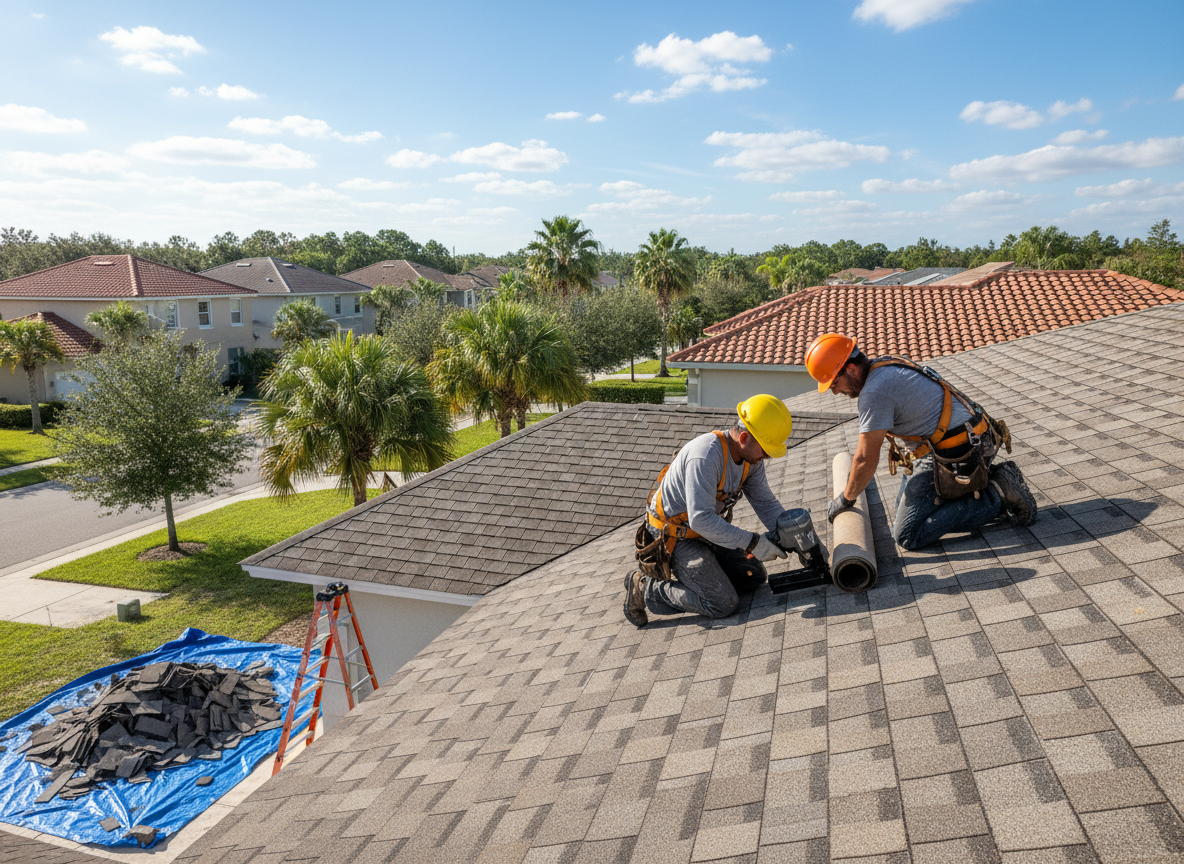
A roof repair is anything short of replacing the whole covering: a section of shingles, a run of tile, a sheet of decking, a flashing detail, a repair to a valley or a hip. The difficulty is not doing the work, it is deciding how much of the roof the work should cover. Get that wrong in either direction and you either pay for a repair that fails within a season or replace a roof that had years left. Call (407) 557-4529.
What Decides How Far a Repair Should Go?
Three things, in this order: the condition of the underlayment, the condition of the deck beneath it, and whether the damaged area crosses a threshold the code cares about.
The underlayment decides most repairs. On a tile or shingle roof it is the waterproof layer, and the covering above it is the wear layer. If the underlayment in the damaged area is pliable and sound, the repair is a covering repair and stays small. If it is brittle, torn or stained, the repair has to include it, because new covering over failed underlayment simply hides the problem.
The deck decides the rest. Any sheathing that has gone soft, delaminated or blackened needs replacing before anything goes back on. That cannot be assessed until the covering is open, which is why an honest repair estimate is written after opening, not before.
The code threshold matters because it decides scope, not because it decides quality. Florida allows a roof that was built or replaced under the 2007 Florida Building Code or later to be repaired in sections, even past 25% of the roof area, with only the repaired section brought up to the current code. Older roofs can trigger wider work once the repaired area passes the threshold. That is a legal fact about scope, and it belongs in the conversation before a homeowner is told a small repair is impossible.
What a repair does not do is reset the clock. A section repair on a twenty-year-old roof leaves a twenty-year-old roof around it, and that context should be said plainly.
Why Repair Rather Than Wait?
Because a small opening gets more expensive at a rate that has nothing to do with the size of the hole.
On a Florida roof, the sequence from a failed detail to interior damage is short. Water enters at the detail, saturates the underlayment around it, reaches the deck, and starts on the ceiling below. The roof part of that sequence is a section repair. The interior part is ceiling board, insulation, paint and possibly a joist. The second is usually the larger number, and it grows every time it rains.
Heat and humidity do the rest. A damp deck in a Florida attic does not dry quickly, and timber that stays damp through a wet season is timber that will need replacing rather than drying out. What would have been a covering repair becomes a covering plus sheathing repair.
There is an inspection argument as well. Roof age is a live issue at renewal in Florida: insurers may not refuse to issue or renew a homeowner policy solely because a roof is under fifteen years old, and for older roofs the insurer has to allow an inspection and cannot refuse on age alone where the roof has five or more years of useful life left. An unrepaired leak is exactly what such an inspection finds, and it undermines the useful-life case faster than age does.
Repairing early also keeps the record clean. A dated repair with photographs shows a roof that has been maintained, which is a different starting point for any later conversation about condition.
What Should a Repair Estimate Show You?
Lines, not a lump sum, and a clear statement of what is being left alone.
A repair estimate should list the covering material and quantity, the underlayment and quantity, any sheathing, the flashing or detail materials, the labor, and disposal. It should say what is not included: which slopes are being left, and what condition they are in.
It should state the permit position for the scope. Florida roofing work is permitted by the local building department, and whether a particular repair needs a permit depends on the scope and your address. Ask which office covers you.
It should identify the failure it is repairing. "Replace 14 field tiles and the underlayment beneath, at the south valley" is a scope. "Roof repair" is a category.
Ask for photographs of the opened area before it is closed, because that is the only chance to see the deck. Ours are on the same paperwork every time: Florida Roof Repair Pros, 4720 Millenia Blvd, Suite 175, Orlando, FL 32839, (407) 557-4529.
The Repair That Was Priced as a Replacement
A homeowner calls about a leak at a rear addition. One slope, roughly a quarter of the roof, is involved. The first company to visit explains the 25% rule: because the repair touches more than a quarter of the roof, the whole roof must be brought up to current code, so it has to be replaced. The quote is for a full replacement.
That version of the rule was the story in Florida for years, and it is still repeated. It is not the whole rule. Under state law, where the existing roof or roof section was built, repaired or replaced in compliance with the 2007 Florida Building Code or a later edition, and 25% or more of it is repaired, replaced or recovered, only the portion being worked on has to meet the current code. The rest of the roof can stay as it is.
So the decisive question is not the size of the repair, it is the age and code history of the roof system. That is answerable: the building department holds the permit record for the last full roof, and it shows the date and the code edition in force at the time. A roof permitted after 1 March 2009, when the 2007 code took effect, is usually in the category that can be repaired in sections.
There is a second layer to the story that matters just as much. Even where a section repair is allowed, it may not be sensible. If the underlayment across the rest of the roof is at the end of its life, the homeowner is buying one more repair now and a replacement in two years, having paid twice. The honest answer to that is a comparison: what does the section repair cost, what does the replacement cost, and how many years does each buy. That comparison is only possible after the underlayment has been looked at in more than one place.
What the homeowner should insist on is that the section repair be priced and explained, not skipped. Where replacement is the right answer, it should win on the numbers and the condition, not on a misquoted statute.
The Work a Roof Repair Includes
Section Repair and Underlayment Splicing
A section repair replaces covering over a defined area and restores the waterproof layer beneath it. The key detail is the splice: new underlayment has to lap over the existing layer in the direction water runs, and the lap has to be sealed.
In Florida, underlayment requirements are set by the Florida Building Code, and in the High-Velocity Hurricane Zone the accepted methods are specified in more detail. A splice that ignores those requirements may pass a visual check and fail the inspection.
A good section repair looks like the original roof at the boundary: same covering, same course alignment, same laps, and no sealant bridging a joint that should be mechanical.
Sheathing and Deck Replacement
Sheathing is the structural surface the roof is built on, and it is the part most often missed in a repair estimate. Soft spots, delamination and black staining all mean the sheet comes out.
On Florida roofs, sheathing damage usually appears at penetrations and valleys first, where water has been arriving for longest. Edge sheathing also goes at the eaves, where wind-driven rain gets under the covering.
Replacement means new sheathing of the correct thickness and span rating, re-nailed to the current schedule, with the panel joints supported. It is not a cosmetic step: a fastener into soft sheathing holds nothing.
Flashing Renewal Against Sealant Repair
A flashing renewal replaces the metal or membrane detail at a junction. A sealant repair coats an existing detail with a flexible compound.
They are not interchangeable. Sealant has a service life measured in a few Florida summers, and it fails at the bond line where the two materials move differently. Flashing, correctly lapped and fixed, moves with the structure.
Renewal is the right answer where the detail is accessible and the underlying material is sound. Sealant is a stop-gap where renewal is not possible, and it should be described as such rather than sold as a permanent repair.
What Should You Ask Before Approving Repair Work?
Ask what failed, in one sentence. If the answer is a category rather than a detail, ask again.
Ask what is being left in place and what condition it is in. A repair scope that does not describe the rest of the roof is not a scope, it is a price.
Ask whether the deck will be inspected when the covering is open, and what happens if it is soft. The answer should be a rate or a method for pricing sheathing, not a shrug.
Ask for the permit position and the inspection sequence. Repairs that require a permit are inspected before covering goes back on, and knowing that in advance tells you how the job will be run.
Ask for the old materials to be photographed before disposal. A photograph of the failed underlayment, the cracked flashing or the wet sheathing is the only evidence you will have that the repair was necessary, and it costs nothing to take.
Then get the whole conversation in writing before work starts. A one-page scope with photographs attached protects both sides, and it makes the final invoice checkable line by line. Florida Roof Repair Pros, 4720 Millenia Blvd, Suite 175, Orlando, FL 32839, (407) 557-4529.
Roof Repair Services We Offer
✓Section Covering Repair
Replacing covering over a defined area with the underlayment spliced and lapped to code.
✓Sheathing Replacement
Soft, delaminated or stained panels replaced and re-nailed before the covering goes back.
✓Flashing Renewal
Junction details replaced in metal or membrane instead of being coated with sealant.
How it works
- 1
Find the failure
The repair is scoped to a named detail, not to a general area of the roof.
- 2
Open and assess
Covering comes up so the underlayment and sheathing can be seen and photographed.
- 3
Write the scope
Materials, quantities, labor and disposal as separate lines, with what is being left in place.
- 4
Permit and repair
The local building department is engaged where the scope requires it, and the work is inspected before closing.
- 5
Photograph and hand over
Images of the opened area and the failed materials, plus the written scope as a record.
Pricing
Repair scopes are written after the covering is opened, because underlayment and sheathing condition decide the extent. The estimate separates covering, underlayment, sheathing, flashing, labor and disposal.