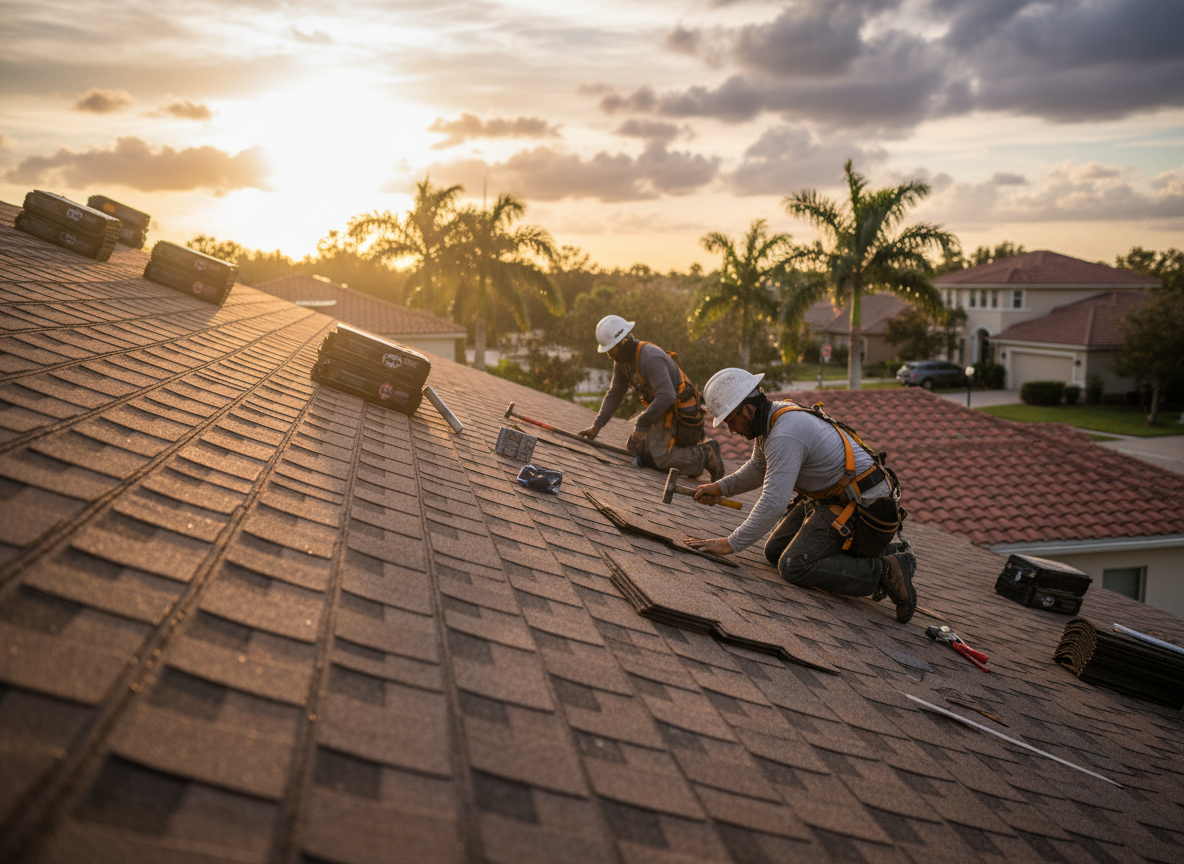
Asphalt shingles are the most common roof covering on Florida's inland housing, and they are also the covering most often misunderstood. A shingle roof is a system: the shingles shed water and take the sun, the underlayment beneath them does the waterproofing, and the ventilation underneath both decides how long either lasts. Judging a shingle roof by the colour of its surface is how homeowners end up replacing a roof that had years left, or keeping one that had none. Call (407) 557-4529.
What Actually Ages a Shingle Roof in Florida?
Sun, heat and moisture cycling, in that order, with biological growth as the visible symptom rather than the cause.
Ultraviolet light breaks down the asphalt that holds the shingle together. In Florida the solar load is high all year, and a roof surface in direct sun reaches temperatures far above air temperature. That heat drives the volatiles out of the asphalt, which is why an older shingle becomes stiff and brittle rather than staying flexible.
Granule loss is the visible measure. The granules on the surface shield the asphalt from UV; as they weather away, the shingle ages faster. Loss is normal over time and concentrates on the slopes that take the most sun and on the field below a ridge where water runs fastest.
Moisture cycling finishes the job. Every afternoon storm in summer drops rain onto a hot deck, and the shingle expands and contracts. Sealant strips that bond one course to the next soften in the heat and harden again, and over enough seasons they stop bonding. A shingle that has lost its seal is still a shingle, but it is one that will lift in wind.
And then there is algae. In Florida's humidity, a blue-green algae commonly colonises asphalt shingles and shows as dark streaking, usually starting from the ridge and running down the slope. It is a cosmetic and moisture problem rather than a structural one, but it marks the slopes that stay damp longest, and it is often mistaken for the roof failing.
Why Does the Underlayment Matter More Than the Shingle?
Because the shingles are not waterproof, and were never meant to be.
An asphalt shingle roof sheds water course by course, and the laps rely on gravity and overlap. In wind-driven rain, water gets underneath. What stops it reaching the deck is the underlayment, a rolled membrane laid over the sheathing before the shingles go on.
That membrane has its own service life, and in Florida it is the item that usually ends a shingle roof's working life. Underlayment fails at the details first, where it is cut and lapped around penetrations, valleys and wall junctions, and that is why the first leaks on an ageing shingle roof tend to be at a vent or a wall rather than in the middle of a slope.
This matters for how a roof is judged. A shingle surface that still looks presentable over underlayment that has gone brittle is a roof at the end of its life, and a homeowner who replaces only the shingles has bought a few years rather than a roof.
It also matters for code. Florida's building code sets out the accepted underlayment methods, and in the High-Velocity Hurricane Zone the requirements are more specific again. A shingle replacement that keeps the old underlayment is not a code-compliant reroof in most circumstances, and it is not a waterproof one either.
What Should a Shingle Roof Scope Include?
The system, named product by product, with the ventilation addressed.
Ask for the shingle product and its approval number. Roof coverings in Florida are approved products, and the approval includes a wind rating and a nailing pattern. A shingle installed outside its approval pattern is a shingle that will not perform to its rating.
Ask for the underlayment product and method. Ask whether the old covering is being removed rather than covered over, and why.
Ask about ventilation: how much intake at the eaves, how much exhaust at the ridge, and whether the two are balanced. An unbalanced roof runs hotter and holds more moisture, and the shingles age faster for it.
Ask about the details: valleys, wall and chimney flashings, pipe boots, drip edge and ridge. These are where shingle roofs leak, and they are the items most often left out of a scope that is priced by the square.
Ours reads the same every time: Florida Roof Repair Pros, 4720 Millenia Blvd, Suite 175, Orlando, FL 32839, (407) 557-4529.
The Eight-Year-Old Roof That Looks Twenty
A homeowner in a subdivision built in the late 2010s calls about dark streaking on the rear slope. The roof is eight years old, has never leaked, and looks markedly worse than the neighbour's identical roof. Two companies have told them the shingles are failing and the roof needs replacing. One has offered to clean it.
Three things are being confused here, and separating them changes the answer.
The streaking is algae. It colonises the north and west slopes first, because those stay cooler and hold moisture longer after rain, and it spreads down from the ridge where moisture collects. It is not a structural failure and it is not the shingles breaking down. It is also not something a shingle roof can be cleaned aggressively: high-pressure washing drives water under the laps and strips granules, which does real damage in exchange for a temporary cosmetic gain.
The second thing is granule loss, which is real ageing and can be read from the ground. Granules collecting in gutters is normal. Bare patches where the mat shows through are not, and neither are bald areas on the slopes that take the most sun. If the shingles are intact and only stained, the roof is not failing.
The third thing is the underlayment and the fasteners, which cannot be judged from the ground at all. On an eight-year-old roof these are usually sound, and the question is worth answering before anyone quotes a replacement.
What a proper assessment does is put a number on each. Coverage of biological growth, expressed as an area. Granule condition, described by slope. Underlayment pliability sampled at a detail. Once those are separated, the options become obvious: clean and monitor, repair a detail, or plan a replacement. Where a homeowner is told the roof must go on the basis of streaking alone, the honest next question is what the underlayment looks like.
One more Florida point: a shingle product with algae-resistant granules is a real specification, and it is worth asking for by name on a replacement. It does not make a roof waterproof, but it does change how the roof looks after eight humid summers.
The Parts of a Shingle Roof System
Algae Streaking and What to Do About It
The dark streaking common on Florida shingle roofs is a blue-green algae that feeds on the limestone filler in the shingle and spreads where moisture lingers. It starts at the ridge and runs down the slope in stripes that follow the water path.
It is cosmetic in the sense that it does not create a hole, but it is a moisture indicator. The slopes that streak first are the ones that dry slowest, and those are the slopes where sealants and fasteners fail first too.
Gentle cleaning and algae-resistant replacement products are the sensible responses. Pressure washing is not: it lifts granules and forces water under the laps.
Wind Ratings and the Nailing Pattern
A shingle's wind rating is a system claim that depends on how it was fixed. The approval specifies a nailing pattern, a nail type and a placement zone on the shingle, and a roof nailed to a different pattern does not perform to the rating.
High nailing, overdriving and placement outside the nail line are the common installation faults, and they are invisible once the next course covers them. That is why photographs of the nailing before the courses close are worth keeping.
In Florida, where a storm can test a roof in its first season, the difference between a rated installation and a habitual one is the difference between losing a few shingles and losing a slope.
Ventilation, Heat and Shingle Life
A shingle roof sits on a ventilated box, and if the box cannot breathe the shingles cook. Intake at the eaves and exhaust at the ridge move hot air out; blocked soffits or a missing ridge vent trap it.
Florida's solar load makes this a life-expectancy issue rather than a comfort one. An attic that runs hotter pushes more heat into the shingle above, and the asphalt ages faster.
A replacement is the moment to balance the ventilation, because the alternative is cutting a finished roof later. Insulation pushed against the underside of the deck is the other common fault, since it stops the roof drying inward.
What Should You Ask Before Choosing a Shingle Roof?
Ask what the product is and what it is approved for. Then ask what underlayment goes beneath it and how it will be fixed at the details.
Ask how the old roof will be removed and whether the deck will be inspected. On a Florida home the deck inspection is the part of the job that decides the final scope, and a scope that assumes a sound deck is a scope that will change.
Ask about ventilation figures rather than assurances: how much intake, how much exhaust, and whether the roof has a balanced path between them.
Ask what the finished roof will look like from the street after a few humid summers, and whether an algae-resistant product is available in the profile you have chosen. It is a fair question in Florida and it has a real answer.
Finally, ask for the handover: approval numbers, photographs of the nailing and underlayment, and the permit record. A shingle roof is a system of parts, and the paperwork is what documents which parts went on. Florida Roof Repair Pros, 4720 Millenia Blvd, Suite 175, Orlando, FL 32839, (407) 557-4529.
Shingle Roofing Services We Offer
✓Shingle Replacement
Tear-off and rebuild with the underlayment and nailing pattern documented before closing.
✓Algae and Surface Assessment
Separating biological streaking from granule loss and shingle failure, slope by slope.
✓Shingle Detail Repair
Valleys, wall flashings, pipe boots and ridge work where shingle roofs actually leak.
How it works
- 1
Assess the system
Shingle condition, underlayment pliability and ventilation are judged separately, not as one impression.
- 2
Name the products
Covering, underlayment and details specified with their approvals before pricing.
- 3
Strip and inspect
Old covering removed and the deck checked sheet by sheet, with sheathing priced by area if needed.
- 4
Install and photograph
Underlayment, nailing pattern and details recorded before the covering closes.
- 5
Hand over
Approvals, permit record and photographs with the finished job.
Pricing
A shingle roof is priced from the deck up: covering, underlayment, sheathing allowance, details and ventilation. The written estimate names each product and separates labor from materials.